India's Silk Industry Sees Renewal with High-Tech Production Methods

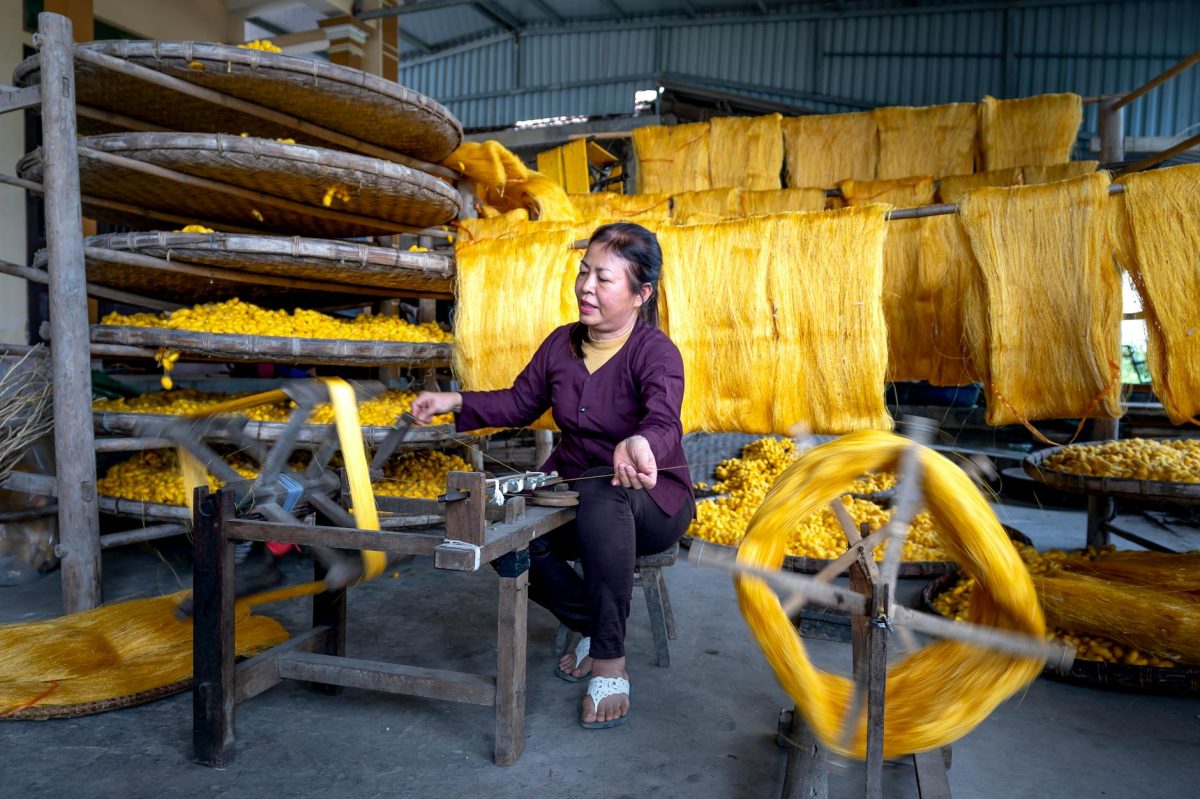
India's Silk Industry Sees Renewal with High-Tech Production Methods
Government initiatives and technological advancements help revitalize the country's silk production sector, with a focus on sustainable and high-quality production methods.
 By 🔗 Original source
India's silk industry is witnessing a significant renewal with the adoption of high-tech production methods, driven by government initiatives and technological advancements. This transformation has the potential to improve the lives of millions of people involved in the industry, from farmers to weavers. As the global demand for silk continues to rise, India's renewal of its silk industry is a promising development for the sector's growth and sustainability.
From Scientist to Silk Farmer: India's High-Tech Silk Industry
The story of Dr. S.K. Singh, a scientist-turned-silk-farmer, exemplifies the changing face of India's silk industry. Dr. Singh, who earned his Ph.D. in sericulture from the Indian Agricultural Research Institute (IARI), decided to leave his academic career to start a silk farm in the state of Karnataka. With the support of the government's sericulture department, Dr. Singh implemented high-tech methods in his farm, including the use of silkworm breeding programs and advanced harvesting techniques. According to Dr. Singh, "Account to the sericulture department, my farm has seen a significant increase in silk production since we adopted these new methods." He attributes this success to the use of high-quality mulberry silk worms, which have a higher yield and better quality than traditional varieties. Dr. Singh's farm is now a model for other silk farmers in the region, and his story highlights the potential of high-tech production methods in the industry. As the government continues to support the adoption of these methods, India's silk industry is likely to see a significant boost in productivity and quality.
Why the Renewal of India's Silk Industry Matters
The renewal of India's silk industry has significant implications for the country's economy and the lives of millions of people involved in the sector. With the global demand for silk continuing to rise, India's position as a major silk producer is likely to be strengthened. This, in turn, will create new opportunities for farmers, weavers, and other stakeholders in the industry. Additionally, the adoption of high-tech production methods is expected to improve the quality and sustainability of silk production, reducing the environmental impact of the industry. As Dr. Singh's story demonstrates, the renewal of India's silk industry has the potential to improve the lives of those involved in the sector, providing better livelihoods and opportunities for growth and development. The Indian government has set a target of increasing silk production by 20% over the next two years, with a focus on sustainable and high-quality production methods.


“"The adoption of high-tech production methods has not only improved the quality of our silk but also reduced our environmental impact," said Dr. S.K. Singh, scientist-turned-silk-farmer.”
What We Don't Know Yet
Despite the promising developments in India's silk industry, there are still several challenges and uncertainties that need to be addressed. One of the key challenges is the availability of skilled labor in the sector, particularly in the areas of sericulture and silk weaving. Additionally, the industry still faces significant competition from imported silk, which can be cheaper and of lower quality than Indian silk. Furthermore, the industry is still grappling with issues related to sustainability and environmental impact, particularly in the areas of mulberry cultivation and silkworm breeding. The Indian government has launched several initiatives to address these challenges, including the establishment of sericulture training centers and the introduction of sustainable mulberry varieties.
What to Watch
In the coming days and weeks, several key developments are expected to shape the future of India's silk industry. One of the most significant developments is the introduction of new sericulture policies, which are expected to provide greater support for farmers and weavers. Additionally, the Indian government is expected to launch a new initiative to promote sustainable silk production, which will focus on reducing the environmental impact of the industry. The industry is also expecting a significant increase in demand for Indian silk in the global market, driven by the growing popularity of sustainable and eco-friendly products.
Despite being a labor-intensive industry, silk production is actually a significant contributor to India's GDP, with the industry providing livelihoods for over 8 million people in rural areas.
The renewal of India's silk industry is a significant development that has the potential to improve the lives of millions of people involved in the sector. With the adoption of high-tech production methods, the industry is expected to see a significant boost in productivity and quality, creating new opportunities for farmers, weavers, and other stakeholders. As the industry continues to evolve and grow, it is essential to address the challenges and uncertainties that still exist, ensuring that the benefits of this renewal are shared by all.